

Key takeaways
- Online Safety Act 2023 is the core legislation
- Highly effective age checks have applied since 25 July 2025
- Ofcom can fine businesses up to £18m or 10% of qualifying worldwide revenue
- Further under-16 restrictions have been announced but are not yet law
If your website, app or platform can be accessed by anyone in the UK, age verification is no longer a "nice to have" — it's a legal duty, with a regulator that is actively issuing fines. The rules are spread across primary legislation, secondary regulations, and regulator guidance that's still being written. That makes it genuinely hard to know what applies to your business and when.
This guide breaks down the UK's age verification and age assurance legislation in plain English: what's already in force, what Ofcom expects "highly effective" age checks to look like, what enforcement has happened so far, and what's coming next — including the under-16 social media restrictions announced in June 2026.
What is the Online Safety Act 2023?
The Online Safety Act 2023 (c. 50) is an Act of the UK Parliament that regulates internet services — primarily "user-to-user" services (social media, forums, messaging platforms with public content) and search engines. It gives Ofcom wide-ranging powers to enforce duties around illegal content, content harmful to children, and fraudulent advertising.
Two things trip businesses up early on:
- Royal Assent is not the same as "in force." The OSA received Royal Assent on 26 October 2023, but the vast majority of its substantive duties only took effect later, through a series of commencement regulations (Commencement No. 2, No. 3, and so on) made by the Secretary of State. Some duties are still being phased in through 2026.
- It applies regardless of where you're based. The OSA applies to any in-scope service with a significant number of UK users, or that targets the UK market — a US or EU-based platform with UK visitors is still caught by it.
The full text is maintained at legislation.gov.uk/ukpga/2023/50, and it's worth checking that source directly for anything commencement-date-critical, since the Act has already been amended by the Digital Markets, Competition and Consumers Act 2024, the Media Act 2024, the Data (Use and Access) Act 2025, and the Children's Wellbeing and Schools Act 2026.
Who does the age verification duty actually apply to?
This is the part most businesses get wrong — they assume it's only "adult sites." It isn't.
The children's safety duties apply to any user-to-user service or search service that is "likely to be accessed by children," which Ofcom interprets broadly. In practice, that captures:
- Dedicated adult content platforms
- Social media and dating platforms
- Gaming and livestreaming services
- Any platform where pornographic or otherwise harmful content could appear incidentally, even if that's not its main purpose
Ofcom has estimated that more than 100,000 online services could fall within scope of these rules — far more than the "porn site" stereotype suggests. If your platform hosts user-generated content, allows messaging, or could plausibly be used by a minor, you need to actually check whether the duties apply to you — not assume they don't.
The core legal duty: Section 82 and the Part 5 pornography provisions
The specific duty requiring "highly effective" age assurance for pornographic content sits in Part 5 of the Act, given effect through Section 82, which came into force as part of the phased rollout. In short: providers must ensure children cannot normally encounter regulated provider pornographic content — full stop, not "discourage," not "warn," prevent.
Alongside this, the broader Part 3 children's safety duties (covering user-to-user services generally, not just pornography) also became enforceable from 25 July 2025. These require in-scope services to:
- Carry out children's risk assessments
- Apply age-appropriate design principles
- Prevent children encountering "primary priority content" (which includes pornography and content encouraging suicide, self-harm or eating disorders)
- Protect children from a wider list of "priority content" that's harmful but not always illegal
- Restrict certain features — including some recommendation algorithms — for under-18 users
What counts as "highly effective" age assurance?
This phrase is doing a lot of legal work, and Ofcom has been deliberately specific about what does and doesn't qualify. To meet the bar, an age check method has to satisfy all four of Ofcom's criteria simultaneously:
- Technically accurate — it actually determines age correctly
- Robust against circumvention — a determined teenager can't easily beat it
- Reliable — it performs consistently, not just in ideal conditions
- Fair — it doesn't unreasonably disadvantage particular groups of users
Methods Ofcom has explicitly ruled out as not highly effective:
- Self-declaration ("I confirm I am 18+")
- Online payment methods that don't themselves require the payer to be 18 (general debit card checks, for instance)
Methods Ofcom has listed as capable of being highly effective (non-exhaustive):
- Photo ID matching (document upload combined with facial comparison)
- Facial age estimation using biometric technology
- Open Banking data checks
- Digital identity services
- Mobile network operator age checks
The word "capable" matters — using a method from this list doesn't automatically make a business compliant. Ofcom expects the implementation to meet all four criteria too, and providers must publish clear information about which checks they use and how user data is handled as part of that.
Enforcement: what's actually happening
This isn't a paper tiger. Ofcom has enforcement powers with real teeth:
- Maximum fines of up to £18 million, or 10% of qualifying worldwide revenue — whichever figure is higher
- Ofcom can also require platforms to change how they operate, and in serious cases can seek business disruption measures
- June 2026 saw Ofcom's first confirmed fine under the age verification rules, issued against a pornography website for failing to have adequate age checks in place
The direction of travel is clear: this has moved from "guidance being finalised" to "regulator actively fining non-compliant businesses" within about 12 months.
What's changing next: the under-16 social media restrictions
On 15 June 2026, Prime Minister Keir Starmer announced that the UK will:
- Ban social media access for under-16s outright on platforms including Snapchat, TikTok, YouTube, Instagram, Facebook and X (messaging apps like WhatsApp and Signal are not expected to be caught by the ban)
- Introduce feature-level restrictions for a wider range of services — including gaming and livestreaming platforms — around stranger contact, livestreaming, and potentially addictive design patterns like infinite scroll
- Require "romantic companion" AI chatbots to enforce a minimum user age of 18, with related restrictions on intimate chatbot functionality more broadly for under-18s
- Task Ofcom with studying what "highly effective" age assurance for the 16-and-under threshold specifically should look like, with findings expected by October 2026
Separately, on 8 June 2026 at London Tech Week, the government announced it will require device manufacturers and operating system providers to build in default, device-level detection and blocking of nude images for children, with a three-month deadline for tech companies to act — again, an announcement with a deadline attached, not yet a statutory duty.
Timeline as things currently stand: the government intends to bring enabling legislation before Parliament before the end of 2026, with the under-16 protections expected to come into force in Spring 2027. This followed a public consultation (March–May 2026) that drew over 116,000 responses, more than 90% supporting a ban. Until the legislation is actually passed and commenced, businesses should treat this as a strong signal of direction rather than a current compliance obligation — but one worth building toward now rather than reacting to later.
Where data protection law fits in
Age verification inevitably means processing sensitive personal data — ID documents, biometric facial data, or financial data via Open Banking. That pulls in UK GDPR and the Data Protection Act 2018 alongside the OSA itself, with the ICO (not Ofcom) as the relevant regulator for how that data is handled.
The practical takeaway for businesses choosing an age assurance method or provider: compliance isn't just "did we check the age correctly" — it's also "did we minimise, secure and appropriately retain the data used to check it." A method that satisfies Ofcom's four criteria but handles data carelessly still creates real legal and reputational risk under a separate regulatory regime.
A practical compliance checklist
If you run a UK-facing platform that could plausibly be accessed by under-18s:
- Establish whether you're in scope. "Likely to be accessed by children" is broader than most businesses assume — don't self-exclude without checking.
- Run a children's risk assessment and document it.
- Remove self-declaration and basic payment checks as your sole age gate — they no longer meet the legal bar.
- Implement a method from Ofcom's "capable of being highly effective" list, or work with a specialist age assurance provider that does.
- Publish clear information on the age checks you use and how the resulting data is handled.
- Review your data minimisation and retention practices for whatever personal data your age checks generate — not just the age-check outcome itself.
- Watch the under-16 legislation as it moves through Parliament — if your service could plausibly be used by 13–15 year-olds, this is worth planning for ahead of Spring 2027, not after.
How Checkify fits into this
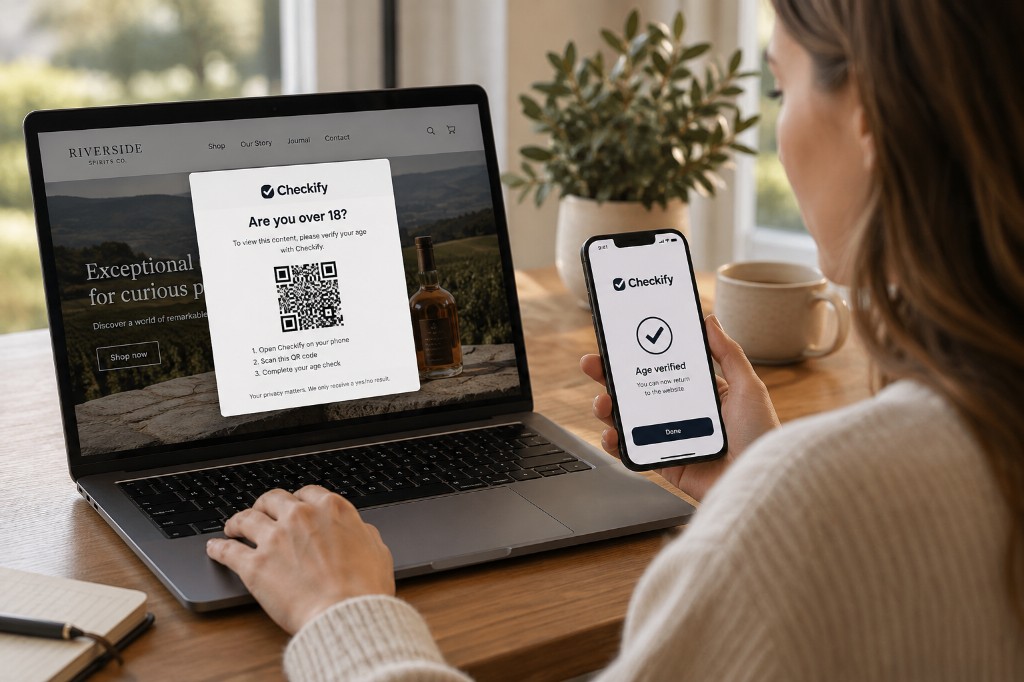
We built Checkify specifically for this environment: age and identity verification that meets Ofcom's "highly effective" bar without businesses having to become data controllers for sensitive documents and biometric data they never wanted to hold in the first place.
The core of our approach is confirmed zero raw data storage — verification happens, an age/identity outcome is returned, and the underlying document or biometric data isn't retained by us afterwards. Data in transit is encrypted using TLS. That's a meaningfully different model from providers who market themselves as privacy-first while continuing to store the raw identity data behind the scenes.
Checkify allows businesses to receive the answer they need without receiving the underlying identity document.
Frequently asked questions
Does UK age verification law apply to businesses based outside the UK?
Yes. The Online Safety Act applies to any in-scope service with a significant number of UK users or that targets the UK market, regardless of where the business is headquartered.
Is "I confirm I am over 18" tick-box verification still legal in the UK?
No. Ofcom has explicitly confirmed that self-declaration does not meet the "highly effective" age assurance standard required under the Online Safety Act.
What happens if a business doesn't comply with UK age verification rules?
Ofcom can issue fines of up to £18 million or 10% of qualifying worldwide revenue, whichever is greater, and can require operational changes. Ofcom issued its first fine under these specific provisions in June 2026.
Is the under-16 social media ban law yet?
No. It was announced by the Prime Minister on 15 June 2026 and is expected to be brought to Parliament before the end of 2026, with protections coming into force in Spring 2027. It is not currently an enforceable legal obligation.
What age assurance methods does Ofcom consider acceptable?
Ofcom has listed photo ID matching, facial age estimation, Open Banking checks, digital identity services and mobile network operator checks as methods capable of meeting the "highly effective" standard — provided the specific implementation is technically accurate, robust, reliable and fair.
Make your first age proof request
If you're working out how the OSA's age assurance duties — or the under-16 changes coming in 2027 — apply to your platform, talk to Checkify and we'll walk through what's actually required for your specific service.